DePIN for Impact: The Special Battery That Decentralises Energy Where It Matters Most

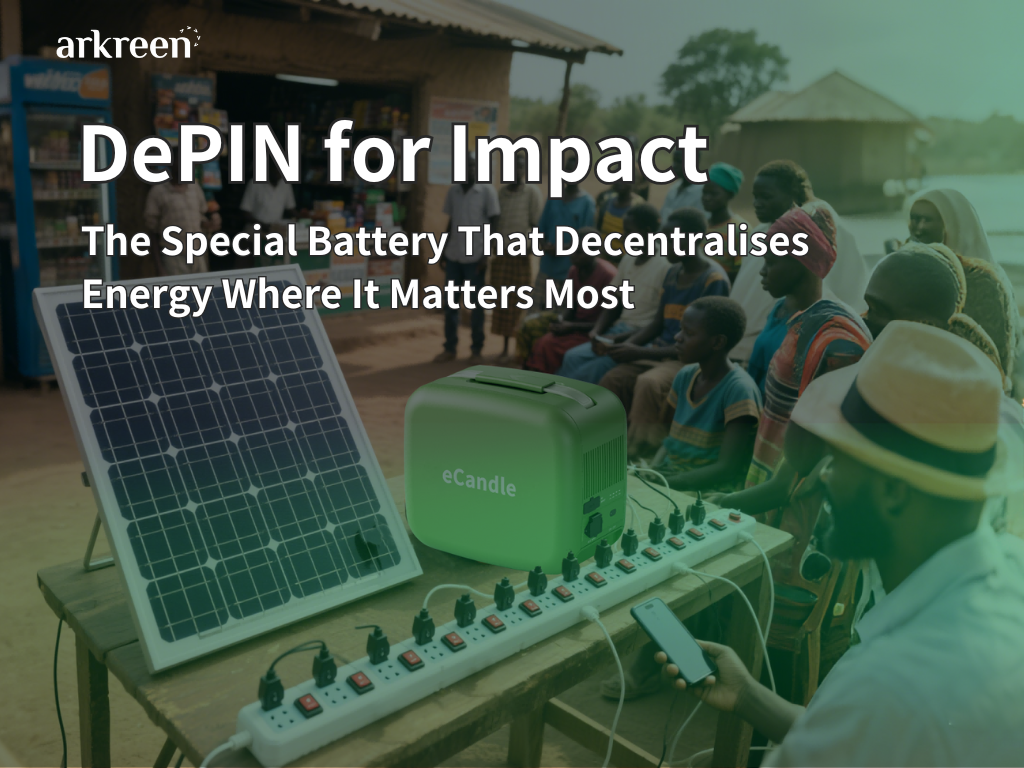
Introduction to a practical revolution in decentralised energy
Decentralisation is a concept people debate, but rarely deliver at scale. At Arkreen Network we turned that debate into a program of pragmatic experiments and field deployments. DePIN for Impact is our first operational model that combines resilient battery hardware, solar generation, local payment rails, and a blockchain backbone to deliver predictable income, reliable power, and measurable social value in places with fragile grids or no grid at all.
Why the battery matters more than you think
- Power is not binary, it is local: The biggest leverage for impact is not bigger turbines or grand grids, it is reliable, affordable energy available at points of need: shops, clinics, schools, community hubs.
- Solar plus storage is the multiplier: Solar panels generate the resource, batteries make it usable when demand arrives, and together they turn intermittent sun into a dependable service.
- Cost and durability decide scale: For emerging markets, price per kWh, ruggedness, and simple serviceability are the blockers. If a battery fails in a remote location, the whole value chain collapses.
The right battery for hard places: eCandle by Faith Batteries
We partnered with Faith Batteries because the eCandle was designed for harsh conditions and continuous reliability. It is compact, robust, and built with field realities in mind. That hardware baseline matters. Without a hardware choice tuned for dust, heat, and irregular servicing windows, any upside from tokenomics or payments evaporates.
The deployment model, in three parts
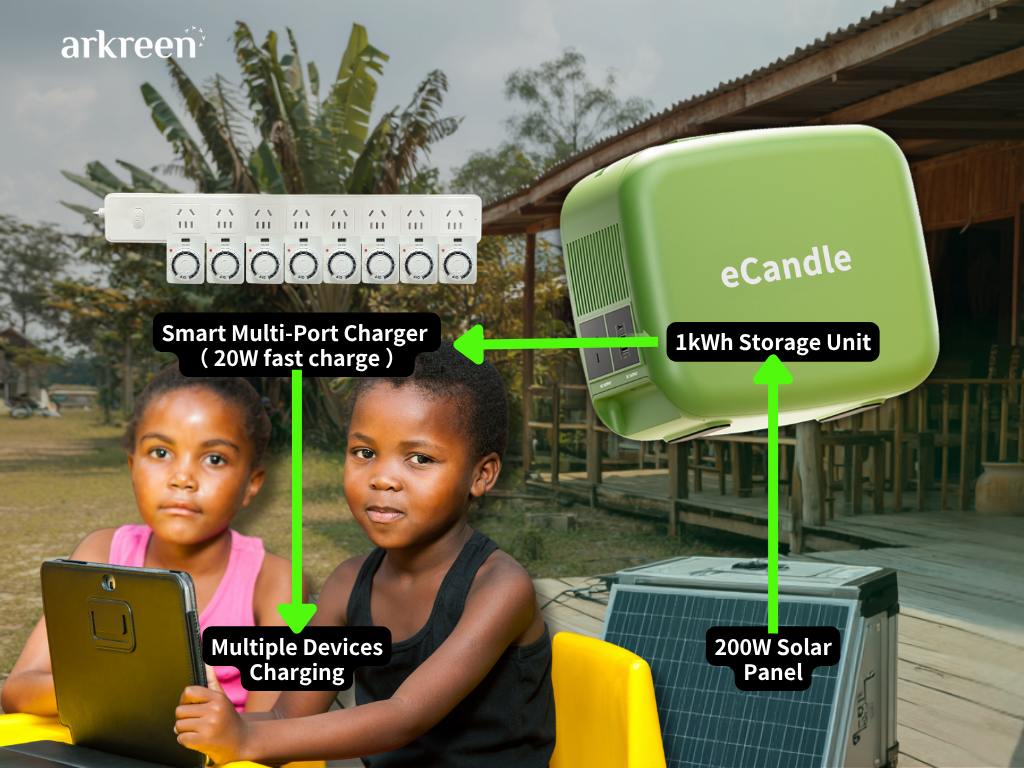
- Hardware and firmware
- Battery: eCandle units optimised for rugged environments.
- Solar: modest panels sized to match local insolation and load profile.
- Controlled sockets: multi-output system to support charging, lighting, and small appliances.
- Firmware: local intelligence for load management, telemetry, and secure payment-triggered energy release.
- Local front-end and payments
- Local payment rails: customers pay in local currency using familiar mobile payment apps.
- Payment conversion: the payment provider converts revenue into a stable coin on the backend.
- Real-time split distribution: revenue is split instantly between investor, operator/caretaker, and service provider.
- Blockchain as distribution and trust layer
- DePIN distribution: token-incentivised rollouts via trusted local partners.
- Transparent accounting: on-chain settlement provides auditable flows and clear ROI signals.
- Community governance potential: over time the network can adapt allocation rules through local representation.
How the economics work, simply
- An investor finances a full kit (battery, panel, sockets, deployment).
- Arkreen and local partners deploy to scouted locations: shop owner, micro-entrepreneur, community hub.
- Locals pay a micro fee to charge devices or buy light time using a popular regional payment app.
- The payment provider converts the fee to stable coin on-chain and triggers a revenue split: a share for the caretaker, a fee for the payment provider, and a major share back to the investor as ROI.
- Caretakers receive a predictable income stream, communities gain access to reliable power, and investors get verifiable returns.
This model aligns incentives and creates a replicable unit economics template that scales.

Why Africa is our initial focus
- Opportunity density: large populations, high mobile payment adoption, and a critical need for decentralised energy services.
- Dense micro economies: small shops and kiosks are natural hosts for shared energy assets.
- Faster adoption curve: where alternative solutions are scarce, pragmatic, affordable offerings spread quickly.
We begin in Kenya for proof of concept. First batteries are en route, and logistics, distribution paths, and community partnerships are being finalised.
The operational tight spots we are solving now
- Logistics: routing, customs, and last-mile handoffs require surgical planning.
- Community scouting: identifying sites with sustained demand and trustworthy caretakers.
- Serviceability: training local technicians and ensuring a parts and service flow.
- Payments integration: ensuring conversion and settlement are reliable and low cost.
We are deliberately starting with qualified partners and established NGOs to iron out these friction points before wider community onboarding.
Beyond phone charging: bigger impact vectors
- Evening lighting for schools and clinics: extend study hours and improve patient care.
- Small business electrification: refrigeration for produce, simple refrigeration for medicines, and reliable POS devices.
- Mini-grids and aggregation: at scale, these units can feed local micro-grids or provide demand response services.
Yet the most important move is to embed these deployments into a Web3 narrative, with clear on-chain transaction histories that make performance and social impact auditable.

Why DePIN is the multiplier
DePIN is not a marketing label, it is a distribution strategy that changes the economics of rollout. By tokenising ownership, aligning investors, caretakers, and payment providers, and using local partners for deployment, we accelerate the scaling curve while preserving local agency and predictable returns.
What success looks like
- Measurable uptime and adoption in pilot sites.
- Predictable, verifiable revenue flows back to investors and caretakers.
- Community uptake beyond initial users, driving organic growth.
- Replicable SOPs for logistics, training, and partner onboarding.
Success is not a press release. It is a reproducible operating playbook that reduces friction for every subsequent deployment.
Next steps and how the community can engage
- Field testing in Kenya, iterating firmware and front-end flows.
- Deepening partnerships with payment providers and NGOs.
- Preparing a staged community rollout after we validate operational resilience and unit economics.
- Publishing technical notes, case studies, and data from the pilots so the sector can learn and iterate faster.
Closing note
This is an operational story, not a whitepaper hypothesis. We have the hardware, the payments partners, the model, and the first batteries in transit. The remaining work is execution at scale, community trust building, and product iteration in the field.If you are an investor, partner NGO, or local operator who wants to help move this from pilot to scale, get in touch with Arkreen Network. We are in the business of practical decentralisation, and we measure impact in devices that keep a business open, a child studying, or a clinic operating through the night.
Short call to action
Follow our pilot updates, join the conversation, and watch the data as DePIN for Impact moves from field trials to repeatable deployments.