Exploring the Future of Renewable Energy: Arkreen at DePIN Summit 2023

On On August 31st, Leo Lin, founder of Arkreen, was invited to attend the DePIN Summit 2023, which was organized by the renowned investment…
Exploring the Future of Renewable Energy: Arkreen at DePIN Summit 2023
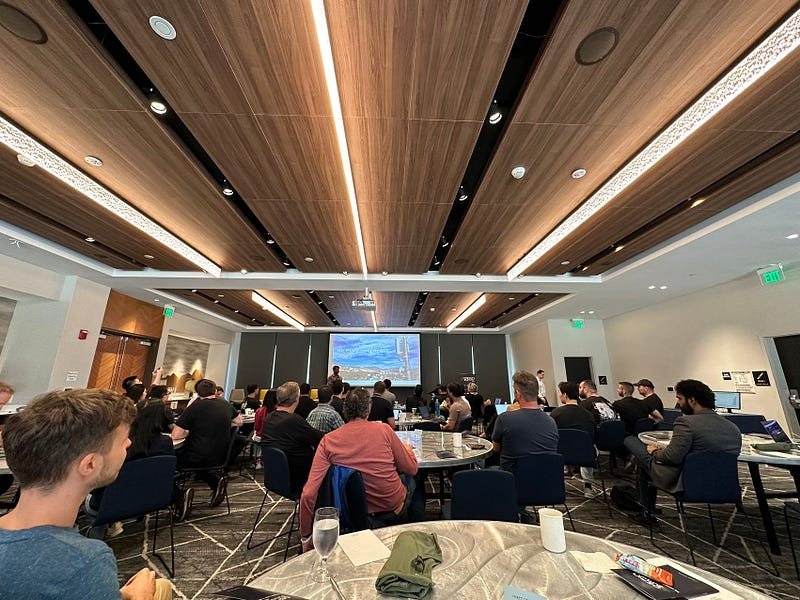
On On August 31st, Leo Lin, founder of Arkreen, was invited to attend the DePIN Summit 2023, which was organized by the renowned investment firm EV3. The event brought together nearly 60 DePIN project representatives and 40 well-known Silicon Valley investment firms, including a16z, Multicoin, Messari, and others, at Mountain View, CA. The summit featured roundtable discussions covering five key areas: wireless, infrastructure, computer & AI, energy, and ID & location. During the Energy roundtable session, Leo participated in extensive discussions with various DePIN projects. The roundtable was moderated by Neel Somani, founder of Eclipse, a project that transformed Solana into an Ethereum Layer 2 solution.
Arkreen: Empowering Distributed Renewable Energy Resources and Green Finance for a Sustainable Future
At the panel’s outset, Leo introduced the Arkreen initiative, which stands as a pioneering effort aimed at harnessing the untapped potential of distributed renewable energy resources and the valuable data they generate. arkreen aims to starting bootstrap residential solar panel connections and update green energy generation data — a potentially transformative endeavor. Every one-thousandth kilowatt-hour of green energy generation could issue a REC. Arkreen progresses with over 1000 miners in its Testnet from this May, Their ambitious near-term objective is to scale up to 10,000 miners while envisioning a global network encompassing one million real-time energy resources in the foreseeable future. Operating as a data network, they monetize green energy data and tokenize RECs, advancing transparency and accessibility in green finance, thus bridging green energy and finance for a more sustainable Web3 community and world.
“We’ve already taken significant steps towards achieving our vision. Since May, we’ve been running a Testnet with over 1000 miners actively participating. Our immediate goal is to scale up to 10,000 miners within the next three to six months. Looking further ahead, in the next two to three years, we aspire to connect a global network of one million real-time resources.”
— Leo Lin, Founder of Arkreen
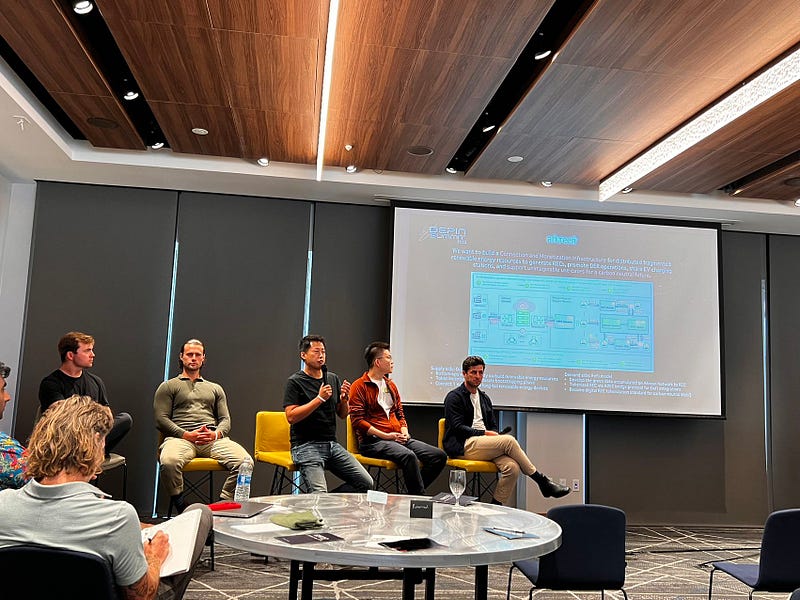
Q1: Navigating Token Launch and Blockchain Integration in the Renewable Energy Sector
Within the panel, moderated by Neel, founder of Eclipse, the discussion unfolds regarding the intricacies of launching tokens and adopting blockchain technology. Leo then explores the potential advantages of blockchain and tokenization for renewable energy sector, which are detailed below:
(1) Tokenizing Renewable Energy Data:
Leo emphasizes the significance of blockchain and tokenization in the renewable energy sector, particularly for ensuring the trustworthiness and verifiability of data collected from green energy sources, such as solar panels. By utilizing blockchain, they can guarantee that the data is secure, transparent, and tamper-proof, making it suitable for creating valuable green financial products like Renewable Energy Certificates (RECs).
(2) Verification and Data Integrity:
Leo highlights that blockchain technology is instrumental in verifying the accuracy of data collected from solar panels. He mentions the use of specialized hardware components, such as data loggers and solid inverters, to ensure that generation data is collected directly from the source with cryptographic signature, making it easily verifiable by third parties. This data integrity is crucial in the context of the legacy energy grid, where reliability is paramount.
(3) Addressing Residential Solar:
Leo also discusses the focus on long-tail residential rooftop solar panels, a market segment that has historically posed challenges in terms of verification and data collection due to its distributed and fragmented nature. In response, Leo suggests the deployment of DePIN methodologies with global community builders and IoT devices to minimize capital expenditure (CAPEX) and operational expenditure (OPEX). By reducing these costs, DePIN can facilitate the development of a more accessible and inclusive green energy data market.
(4) Collaborative Ownership from Web3 Community:
Leo emphasizes the importance of collaboration among industry stakeholders to co-build and co-own data networks. This approach is crucial in creating a robust and sustainable ecosystem for green energy data, especially in the context of smaller, distributed renewable energy sources like residential solar panels.
In conclusion, blockchain and tokenization offer solutions for data reliability, cost reduction, and collaborative ownership in the renewable energy sector, paving the way for a more sustainable energy future globally.
Q2: Unlocking Synergy: Crypto Composability and Renewable Energy Initiatives
In the panel discussion, Neel, in his role as the moderator, directed questions to Leo and other speakers, prompting them to share their perspectives on the convergence of crypto composability and renewable energy projects, as well as the role of subsidies in addressing environmental challenges. Leo provided insightful commentary on the application of blockchain and crypto in advancing green energy initiatives, as outlined below:
(1) Composability and Technical Stack Reuse:
Leo responded by highlighting the importance of reusing existing tools and technologies to enhance scalability and performance. He mentioned to use Filecoin, a decentralized storage solution, for various DePIN projects that require secure decentralized data storage. Additionally, Leo noted that small teams can achieve significant results within the open-source, permissionless Web3 ecosystem, in contrast to traditional giant projects.
(2) Privacy-Preserving and Tokenization:
Leo discussed the hot topic of privacy preservation in the context of DePIN projects. He stressed that the open-source nature of Web3 projects allows them to follow privacy-preserving principles and policies. Furthermore, Leo shared how his team is working with ReFi community to tokenize green data assets, making them more liquid and transparent, while lowering the barrier to entry for demand-side participants in carbon credit trading.
In conclusion, Leo’s response to Neel’s question focused on the adaptability and collaborative nature of Web3 projects, highlighting the reuse of existing Web3 technical stacks, decentralized storage solutions, and the importance of privacy preservation. He also mentioned their approach to tokenizing carbon credits for greater accessibility and liquidity in the renewable energy sector.
For a comprehensive insight into how #DePIN can safeguard humanity in this chaotic era, please click the link below to watch the replay of the event.
https://app.beem.xyz/e/DePIN-Summit-2023_27015D/
By Arkreen on September 4, 2023.