From Hong Kong to Africa: How a Stablecoin Can Light a Lamp

Arkreen eCandle × HashKey Settlement Protocol: When Distributed Energy Meets On-Chain Payment Infrastructure
Two Scenarios
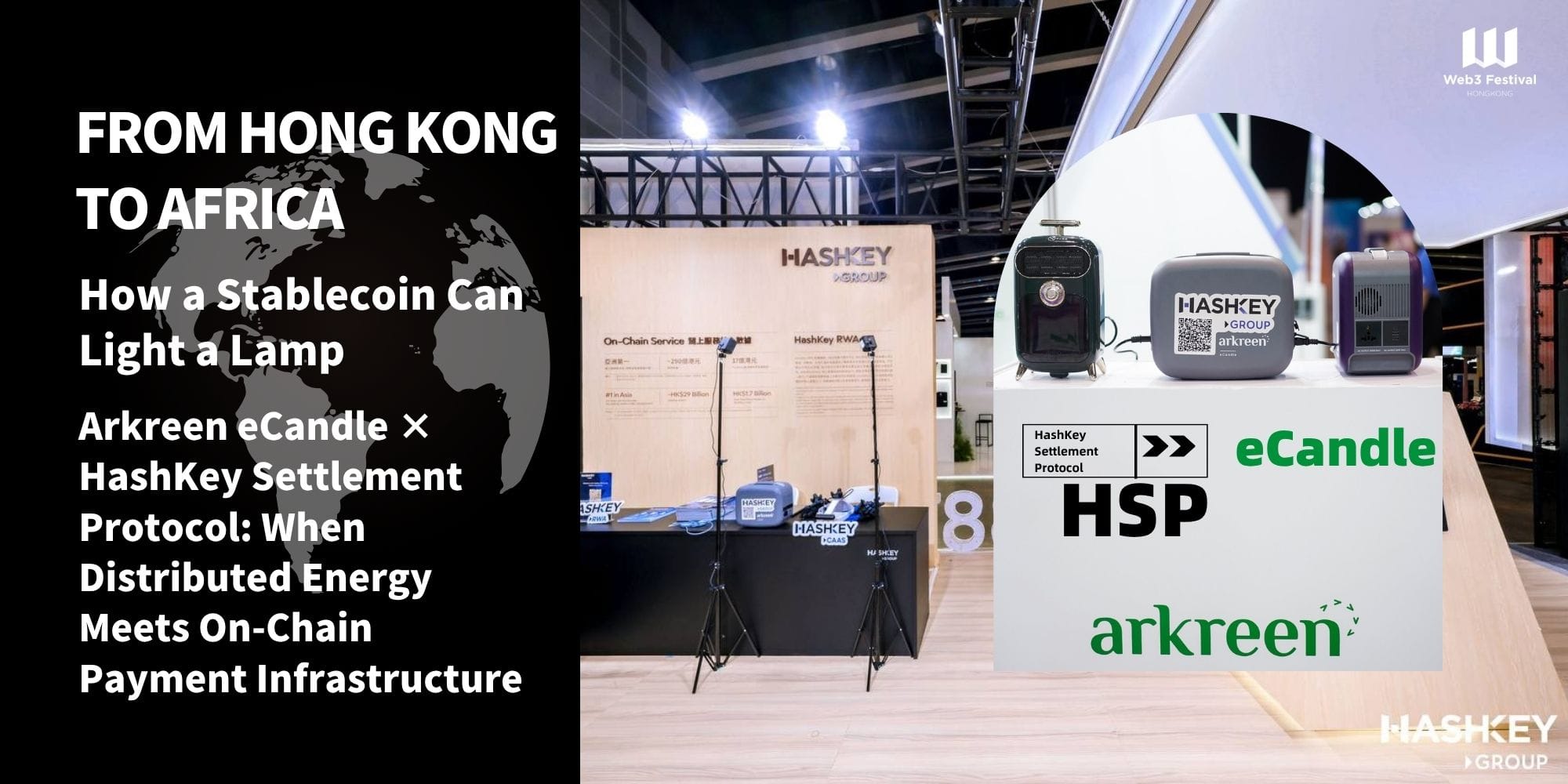
Hong Kong Convention and Exhibition Centre, 2026 Web3 Festival.
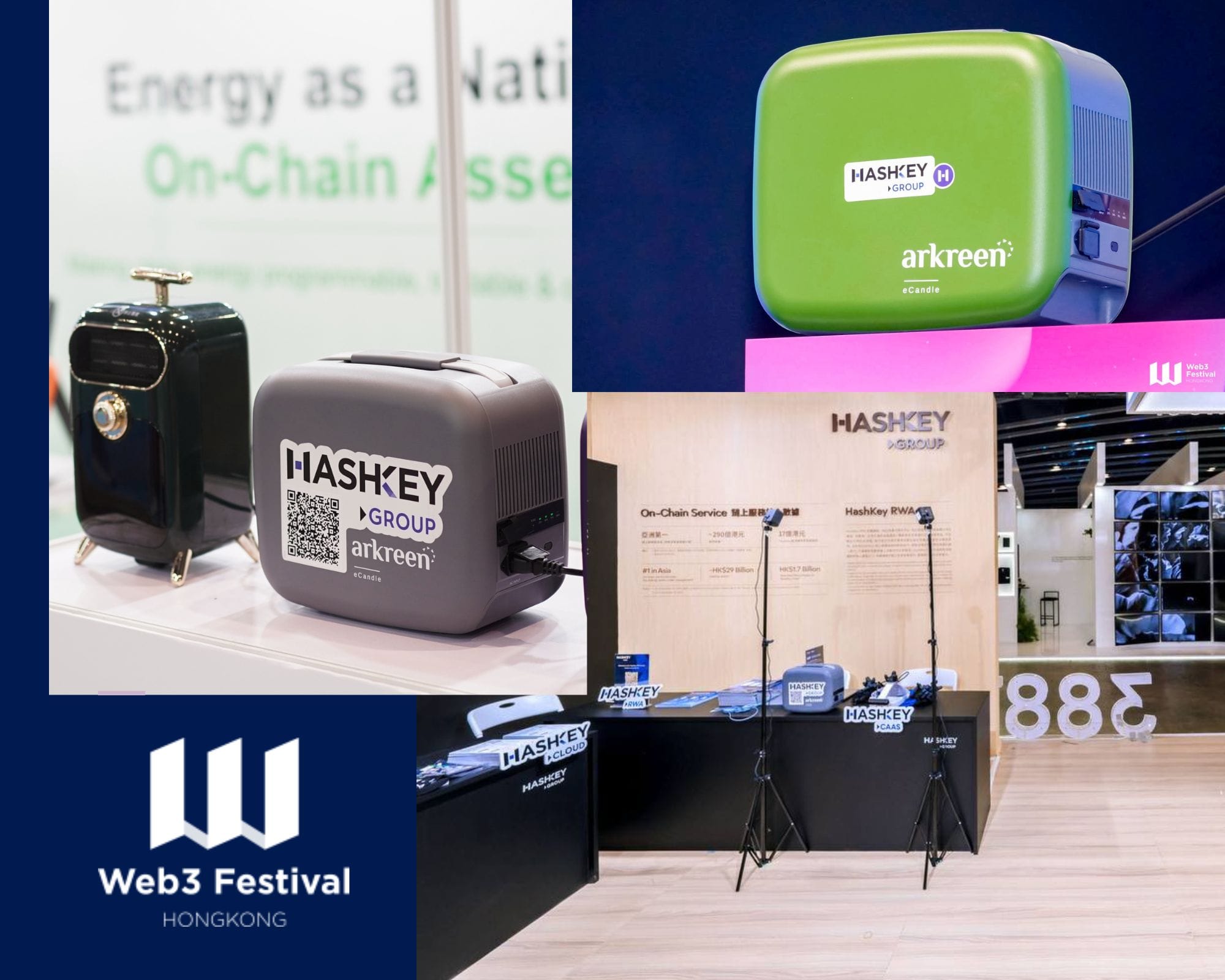
At the Arkreen and HashKey booths, a compact solar-powered device called eCandle sat quietly on display. A visitor took out a phone, scanned the QR code on the device, selected USDC on the HashKey payment page, and tapped confirm. Three seconds later, the device lit up.
No registration. No top-up. No monthly fee. Just an on-chain payment of $0.01 in exchange for 60 seconds of electricity.
At first glance, the action seems almost too simple to matter. But now shift the scene eight thousand kilometers away—
In an off-grid village in central Kenya, night falls with no electricity. A mother wants to help her child study, while the nearest power grid is 50 kilometers away. She has a smartphone, but no bank account.
If an eCandle were in front of her, what she would need to do would be exactly the same as what the visitor did at the Hong Kong booth: scan the code, pay in stablecoins, and the light turns on.
The distance between these two scenes is exactly the road we are now beginning to travel.
eCandle: Scan to Access Electricity
eCandle is a small-scale community solar device created by Arkreen Network for developing countries. It consists of a 200W solar panel and a 1 kWh battery storage unit. Its core logic can be summed up in one simple sequence:
Scan the code → pay in stablecoins → device powers on → power cuts off automatically when time expires.
No grid connection required. No bank account required. No human operator required. A single eCandle is a complete, self-operating solar micro power station.
But for this model to truly work, one critical issue must be solved: payment.
Users in off-grid communities may be using different blockchains, different wallets, and different tokens. Each payment may be as small as one cent. Devices may be scattered across remote areas with no maintenance staff on site. That means the payment system must meet several demanding requirements:
- One entry point that supports multiple chains and multiple tokens
- Gas fees that are never higher than the cost of the electricity itself
- Full automation from payment confirmation to device response
- 24/7 unattended operation
Traditional payment systems cannot meet these requirements. And that is exactly why HashKey entered the equation.
HSP: Payment Infrastructure for the Machine Economy
HSP (HashKey Settlement Protocol) is the core technology behind HashKey Merchant—a multi-chain settlement protocol designed to make on-chain payments as simple as QR-code payments.
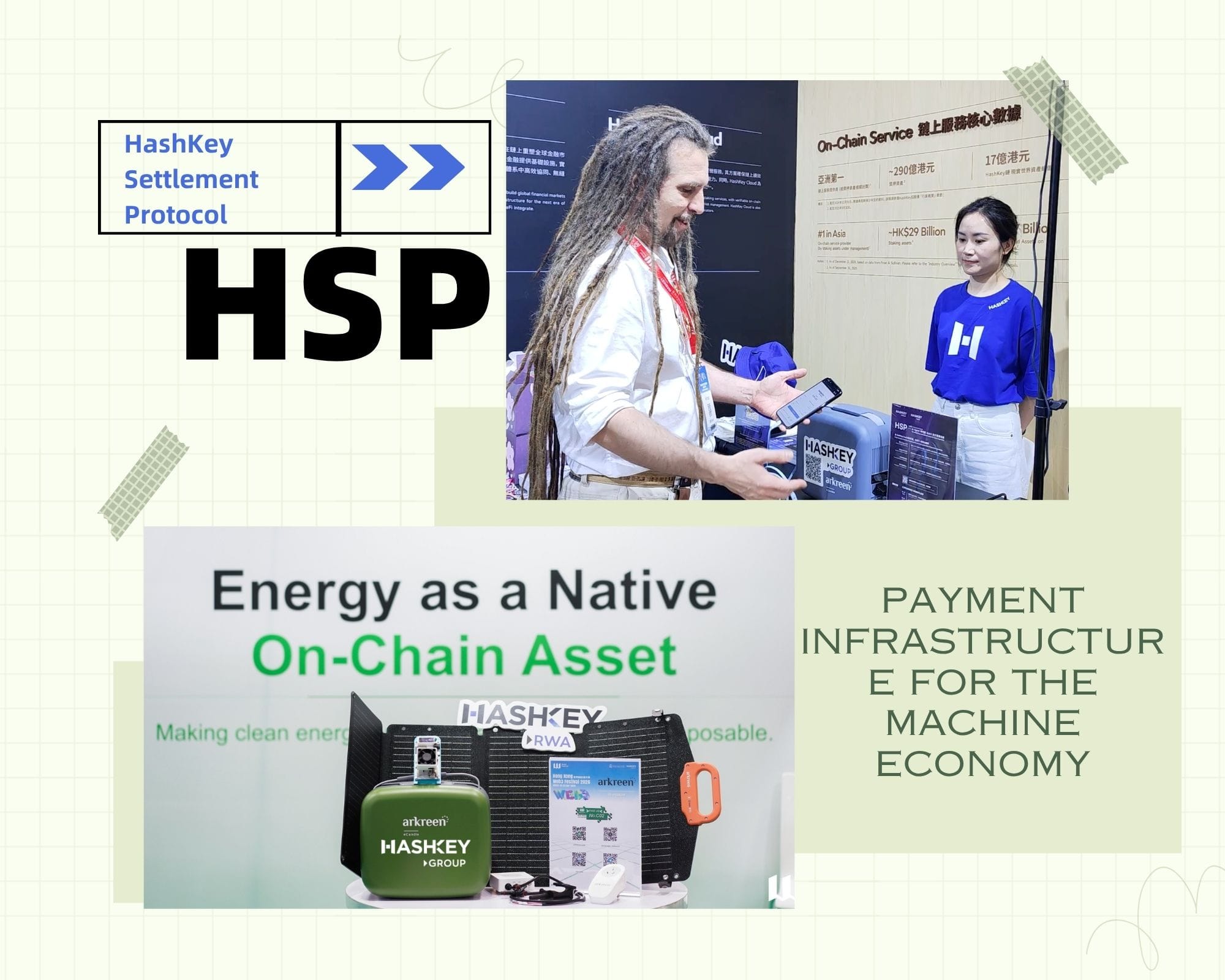
In the eCandle use case, HSP solves three core problems:
Chain abstraction: users do not need to know which chain they are on
When a user scans the QR code on an eCandle, HSP generates a unified payment request (Cart Mandate) that simultaneously supports multiple chains and multiple tokens. The user can pay with USDC on Ethereum, or with USDC or HSK on HashKey Chain—without switching networks and without needing to understand cross-chain bridges.
From the user’s point of view, it is just a payment page and a single button. The complexity of the underlying chains is completely abstracted away.
Gasless: hold tokens and pay
On most blockchains, sending a transaction requires the user to hold the native token (ETH, HSK, etc.) to pay gas fees. For someone who simply wants to spend $0.01 in USDC to buy electricity, having to first go to an exchange to buy ETH for gas is obviously unreasonable.
With HSP, users only need to hold stablecoins in order to complete the payment. Gas fees are handled at the protocol layer, so from the user’s perspective, they are effectively zero.
Automated settlement: from payment to power-on, with no human intervention
HSP’s Webhook mechanism automatically calls back to the eCandle server once payment is confirmed. As soon as the server receives confirmation, it immediately sends a power-on command to the device. From the moment the user taps “pay” to the moment the device lights up, the end-to-end process takes roughly three seconds.
More importantly, HSP supports reusable payment channels (Cart Mandate). A single static QR code can be permanently attached to the device, while each payment is settled independently. This means eCandle can be deployed much like a vending machine—attach the QR code, connect the solar power source, and the device begins operating autonomously.
Web3 Festival: A Joint Debut
This was not the first collaboration between the two companies, but it was the first time they jointly presented the results to the global Web3 community.
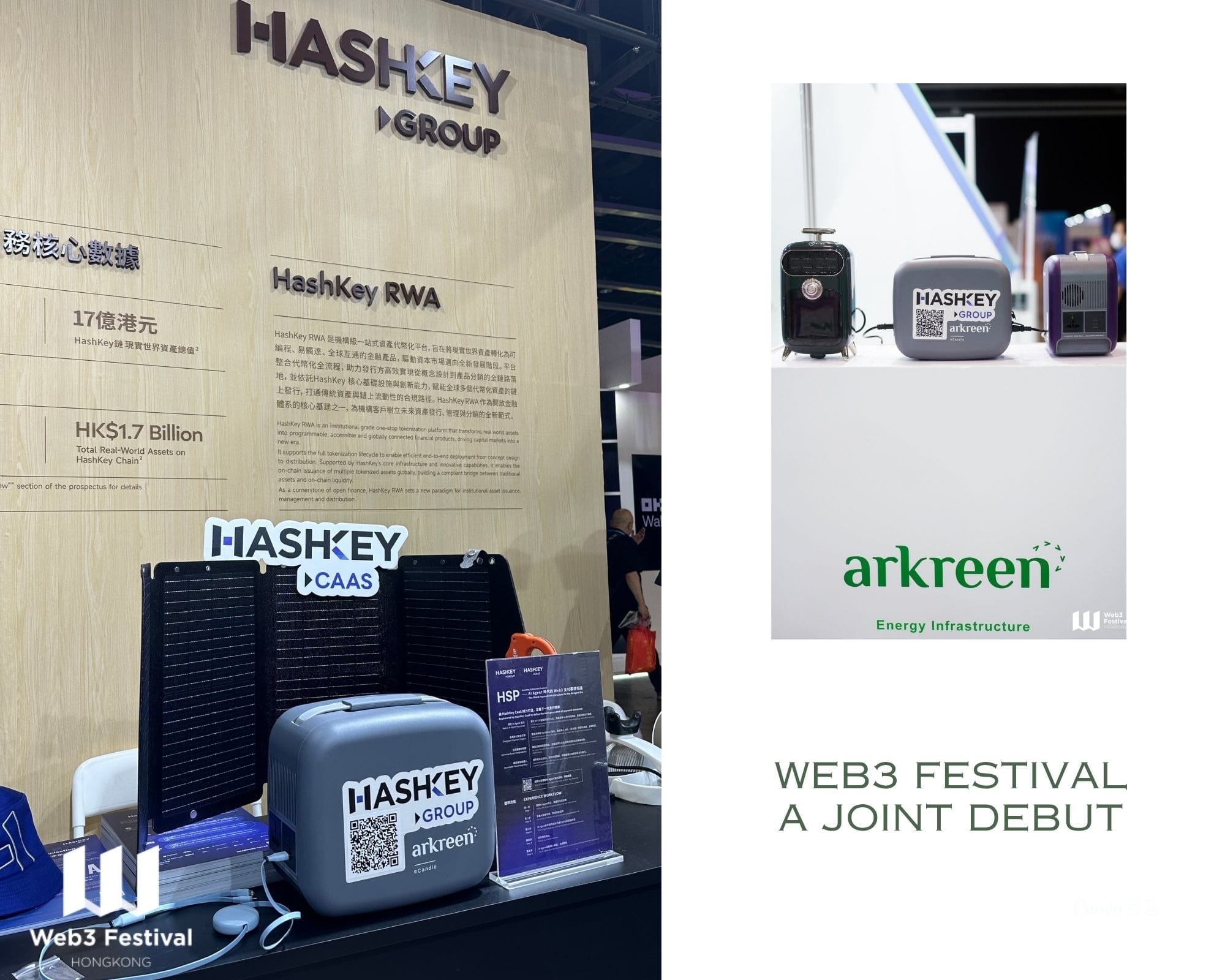
At the 2026 Hong Kong Web3 Festival, Arkreen and HashKey showcased the physical eCandle device together at their respective booths. Visitors could personally experience the entire payment flow: take out a phone, scan the code, choose a token, and make a payment. Then they could watch the device in front of them actually light up. Every payment was recorded on-chain, and every piece of revenue was automatically distributed to the relevant parties.
But the exhibition demo was only the beginning. In the conversations happening around the booth, an even larger plan began to take shape.
Lighting Up Africa: From Demo to Mission
According to 2023 data from the International Energy Agency (IEA), more than 600 million people in sub-Saharan Africa still lack reliable access to electricity.
The conventional solution is to build out the grid—requiring billions of dollars in investment, years or even decades of construction, and complex administrative approvals and infrastructure development.
eCandle offers a completely different path: instead of building the grid, build micro power stations.
An eCandle unit is solar-powered, network-connected, and plug-and-play. Deployment does not require a utility company. Operation does not require on-site personnel. Payment collection does not require a banking system. Its business model is extremely simple: users scan the code and pay for electricity, while revenue is distributed automatically.
Arkreen and HashKey will jointly launch the eCandle “Light Up Africa” Initiative:
Global crowdfunding → device manufacturing → deployment in Africa → on-chain operations
The core innovation of this initiative is that the entire process is transparent on-chain. Here, blockchain is not a gimmick—it is trust infrastructure. Trust for large-scale global community collaboration cannot rely on contracts and audits alone. On-chain transparency is the only scalable trust mechanism.
Why HSP is critical
Inclusive energy access scenarios place even greater demands on payment infrastructure than an exhibition demo:
- Users may only have feature phones: HSP’s QR-code payment does not require app installation
- Transaction amounts may be extremely small: $0.01 or even less, so gas fees must be zero
- Users may hold different stablecoins on different chains
- Devices may operate for long periods without maintenance: static QR codes + automated settlement allow devices to run autonomously after deployment
HSP is not merely the payment tool for this initiative. It is the prerequisite that makes the entire model economically viable.
A More Distant Future: When Machines Pay Machines
There is an even more forward-looking dimension within eCandle’s technology stack: machine-to-machine (M2M) autonomous payments.
This points to an even bigger vision: when IoT devices all have wallets and can make payments autonomously, what we need is not just a “payment gateway,” but rather a settlement layer for the machine economy.
Shared computing power, shared bandwidth, shared sensor data, distributed energy trading—every one of these IoT scenarios can reuse the same paradigm of payment → service → settlement. HSP’s multi-chain settlement capability, together with HashKey Chain’s low-cost and high-throughput characteristics, makes it naturally suited to serve in this role.
Blockchain for Good
The Web3 industry is often asked a difficult question: what real-world problem are you actually solving?
The answer from eCandle × HashKey is very concrete: bringing electricity to people who do not have it.
Not through donations—because donations are not sustainable. But through a self-sustaining economic system: users pay for electricity, investors earn returns, operators generate revenue, and devices run autonomously. Blockchain ensures that every step is transparent and trustworthy. HSP ensures that payments are frictionless and accessible to all.
From a booth in Hong Kong to villages in Africa, the technology stack remains the same. What changes is who uses it—and whose life it transforms.
Blockchain for Good is not about assuming blockchain itself is inherently good. It is about choosing to use it for good.
Powered by Arkreen Network × HashKey Settlement Protocol