Hong Kong Web3 Festival Day 2 | DePIN HK Forum Brings Together Global Leaders in Web3 and Physical…

Updates on Sub-stage 3:DePIN- Web3 & Physical Infrastructure Networks
Hong Kong Web3 Festival Day 2 | DePIN HK Forum Brings Together Global Leaders in Web3 and Physical Infrastructure
Updates on Sub-stage 3:DePIN- Web3 & Physical Infrastructure Networks
The DePIN HK: Building a Global Digital Infrastructure Network with Web3 Economic Incentives forum was held on the second day of the Hong Kong web3 festival on April 13th, 2023. This eagerly awaited event was organized jointly by arkreen, Wanxiang Blockchain, and HashKey Group and brought together prominent individuals from the Web3 community to explore the latest advancements and the groundbreaking impact of DePIN on the integration of the virtual and physical worlds.
Dr. Xiao Feng, Chairman of Wanxiang Blockchain and Hashkey Group, and Leo LIN, founder of arkreen, along with collaborators from various industries, have launched the “DePIN Hong Kong Initiative” to foster collaborative development through the use of blockchain technology and hardware devices to build the DePIN ecosystem in Hong Kong and globally. The initiative plans to use a token incentive mechanism to encourage collaboration on physical infrastructure networks worldwide, with a particular focus on the Greater Bay Area. This initiative is expected to make a significant contribution to the development of Hong Kong’s digital economy and will inject new momentum into the city’s digital era.
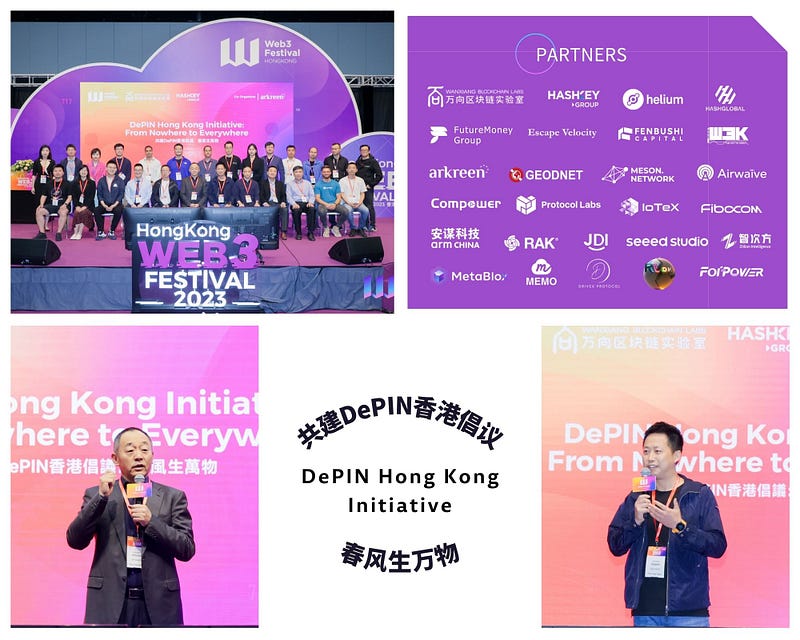
Dr. Xiao Feng, Chairman of Wanxiang Blockchain and Hashkey Group, and Leo LIN, founder of arkreen, along with collaborators from various industries, have launched the “DePIN Hong Kong Initiative”
During the event, the keynote speakers shared insights on DePIN’s projects and how they are redefining the construction logic of the global hardware infrastructure network. Representatives from globally recognized projects like Helium, W3K, IoTeX spoke about their individual contributions to the DePIN model, which leverages Web3’s economic incentive model and smart contract collaboration mechanism to mobilize a global community to deploy physical infrastructure at an unprecedented pace and cost.
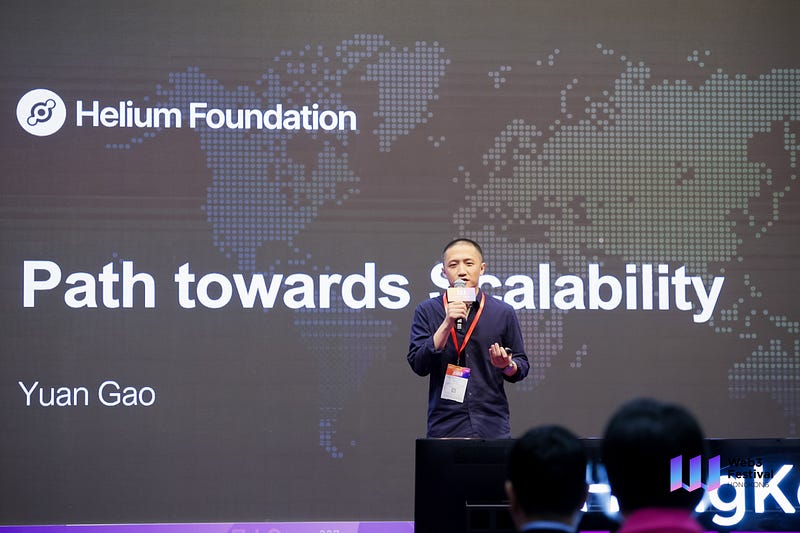
Yuan GAO, Head of Growth at Helium Foundation; Keynote topic is ” Helium status update -path towards scalability”
Yuan GAO, Head of Growth at Helium Foundation, spoke about the importance of scalability for DePIN networks. He emphasized the need for permissionless access and tokenomics, and highlighted the significance of integrating the network layer with clearing and settlement to create a marketplace that eliminates intermediaries and reduces costs. Helium has achieved significant milestones in its development, including a global network of over 1 million LoRa hotspots in 192 countries and a private 5G network in the US with almost 9,000 small cells. It also supports open-source development, with 40 manufacturers providing IoT access devices. The network has transmitted over 100 million data packets and hundreds of thousands of sensors used it in the last month, indicating high activity and usage. Helium’s key strategies as a DePIN player include collaborating with existing LoRa service providers to expand their network and offer application solutions, creating a “network of networks” by serving as a foundational infrastructure for other decentralized wireless networks, and providing early support through HNT investments for these networks to avoid the need for them to build their own infrastructure.
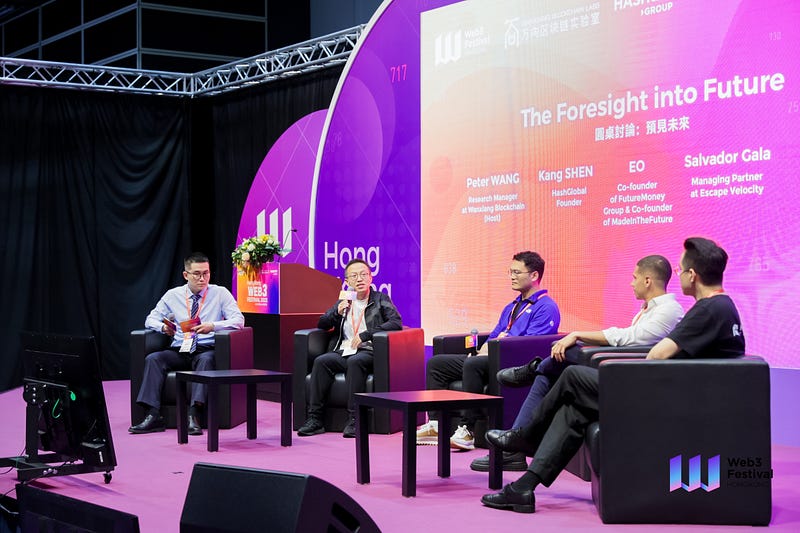
Panel 1 “The Foresight into Future” was hosted by Peter Wang, researcher at Wanxiang Blockchain, and guest speakers included Kang Shen, founder of Hashglobal; EO Hao, founder of FutureMoney; Salvador Gala, managing partner of EV3; and Kobby Chen, Investment Director of Fenbushi.
Following Yuan’s presentations, the first panel of the DePIN event was centered on DePIN investors and alpha researchers, and was titled “The Foresight into Future”. The panel was hosted by Peter Wang, researcher at Wanxiang Blockchain, and guest speakers included Kang Shen, founder of Hashglobal; EO Hao, founder of FutureMoney; Salvador Gala, managing partner of EV3; and Kobby Chen, Investment Director of Fenbushi. During the panel, the participants discussed various aspects of the DePIN ecosystem, such as business models, products, user experience, market space, and token economics. They also stressed the importance of adopting Web3.0 thinking and recognizing DePIN’s unique value creation model. The panelists also discussed how investors evaluate investment ideas based on changes and non-changes in the industry. They highlighted that DePIN is a new area for individual investors, and suggested that evaluating behavior patterns and continued participation in the network is crucial. Additionally, for early-stage internet investments, traditional asset evaluation methods may not apply, and investors may need to focus on non-tangible assets such as user base and brand value. The panel concluded that a network-based approach is necessary for evaluating these types of startup companies.
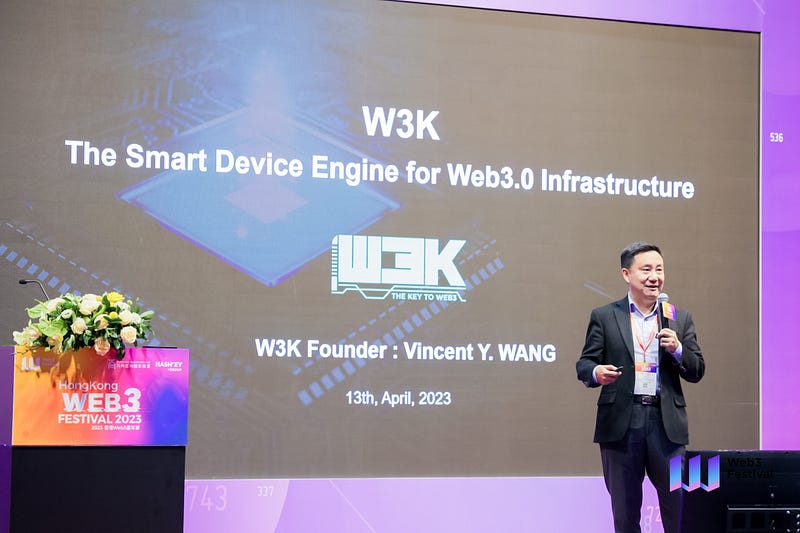
Vincent Wang, Founder of W3K;Keynote topic is “W3K•the Smart Device Engine for Web3.0 Infrastructure”
Vincent Wang, Founder of W3K, explained that W3K stands for “Key to Web3.0” and is a physical key that is an intelligent device capable of supporting and developing the token economics architecture. The device can be used by Web3.0 project teams to operate DEPP without worrying about chips or hardware. This is the main function presented around the token economics technology architecture, which is also the core of W3K. Vincent talked about concerns with copyright and carbon reduction, using the example of incorporating a low-carbon economy into daily life in Hong Kong. He emphasized the importance of incentivizing users through a token layer and the role of smart hardware in providing governance incentives. He also discussed the potential of Web3.0 hardware in protecting data sovereignty and enabling personal data exchange and transactions. Vincent encouraged the audience to join the community and innovate with tokens to win the battle.
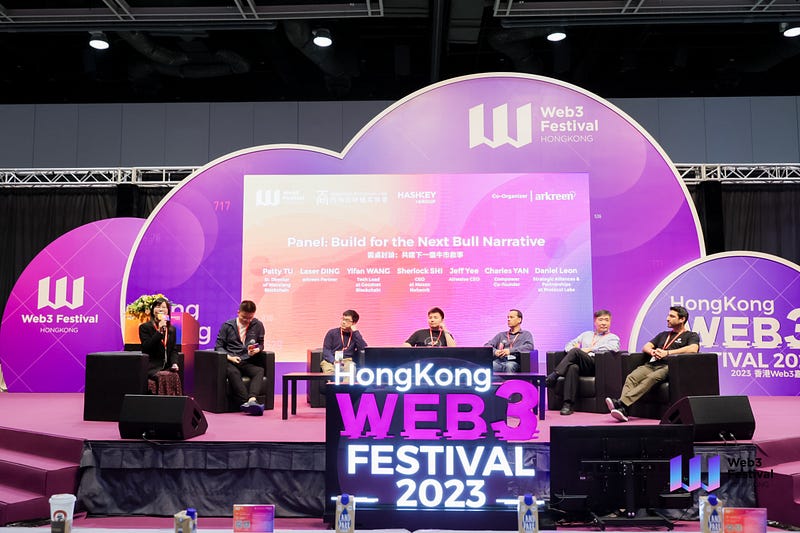
Panel 2 “building in the next bull narrative” was moderated by Patty Tu, Senior Director of Wanxiang Blockchain, the panel included Laser Ding, partner of Arkreen; Yifan Wang, co-founder of Geodnet; Sherlock Shi, CEO of Meson Network; Jeff Yee, CEO of Airwaive; Charles Yan, technical advisor of Compower; and Daniel Leon, Head of Strategic Alliances & Partnerships of Protocol Lab
During the second panel, DePIN Builders were invited to discuss strategies for building in the next bull narrative. Moderated by Patty Tu, Senior Director of Wanxiang Blockchain, the panel included Laser Ding, partner of Arkreen; Yifan Wang, co-founder of Geodnet; Sherlock Shi, CEO of Meson Network; Jeff Yee, CEO of Airwaive; Charles Yan, technical advisor of Compower; and Daniel Leon, Head of Strategic Alliances & Partnerships of Protocol Lab. The panelists highlighted the advantages of DePIN applications, such as the rapid and massive deployment of the network, the availability of mature financial tool infrastructures on the blockchain, and the reduced need for intermediaries. They also discussed how blockchain and tokens incentivize users to build the DePIN network, with tokens encouraging early adopters and helping to match supply and demand in the time dimension. Tokens were also identified as a means of covering valuable users in the long tail who may not have been properly incentivized.
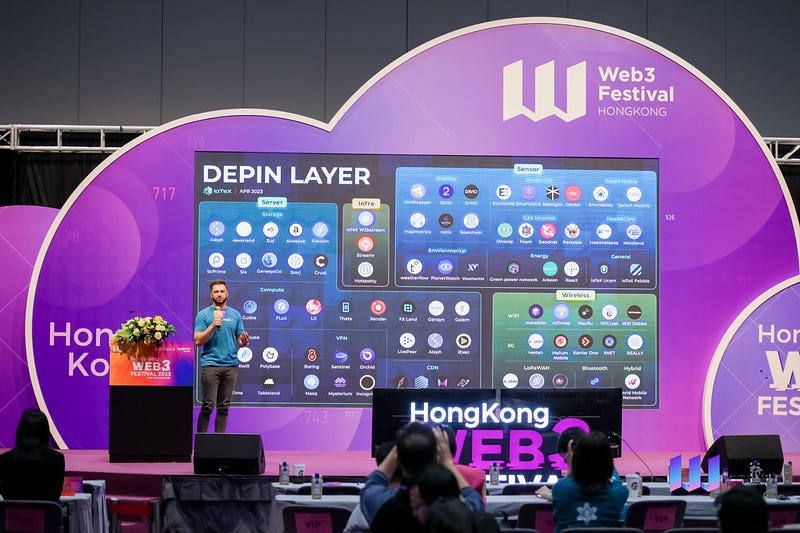
Aaron Basi, Head of Product at IoTeX; Keynote topic is “Empowering DePIN Innovation”
The third keynote speaker, Aaron Basi, who is Head of Product at IoTeX, spoke about Empowering DePIN innovation. He highlighted the challenges that come with creating the DePIN network, a new technology that requires data from centralized electronic centers. Aaron also introduced W3bstream, a decentralized protocol developed by IoTeX that allows end-to-end data transfer without a centralized app or protocol. W3bstream can be used with any device or data source on any blockchain, and it provides strong computing power. Developers can use their own computing logic to design usage patterns and examples in different languages by logging into the W3bstream Studio website with their MetaMask wallet. Aaron believes that the infrastructure can be implemented in various industries, and he encourages developers to explore their open-source services and participate in discussions about the protocol.
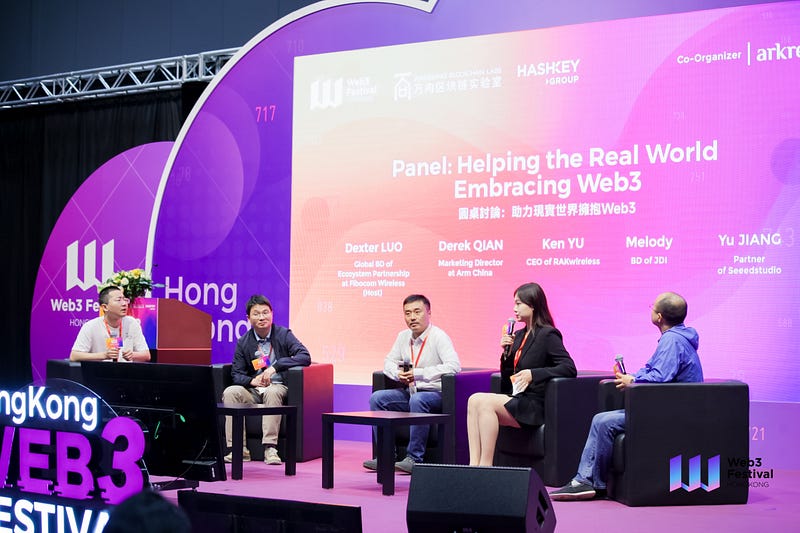
Panel 3 “Helping the Real World Embracing Web3” was led by Dexter LUO, GM of Fibocom Ecosystem, joined by Derek Qian, marketing director of Arm CHINA; Ken, CEO of RAKwireless; Melody, BD of JDI; Yu Jiang, partner of Seeed Studio
The third panel, led by Dexter LUO, GM of Fibocom Ecosystem, discussed integrating Web3 with the real world through hardware manufacturing and production. The DePIN enablers highlighted the importance of companies focusing on their strengths and delivering quality products while navigating the crypto cycle. Melody, BD of JDI, shared their collaboration with DIMO and Wicrypt to promote DePIN projects, while Yu Jiang, partner of Seeed Studio, is working on outdoor sensors and supportive software to make DePIN more accessible. Ken, CEO of RAKwireless, shared their experience integrating hardware manufacturing with the token economy, highlighting the challenges of managing the supply chain cycle and dealing with rapid crypto price declines. The panelists also discussed their plans for innovation, stable projects, and contributing to the development of blockchain decentralization through high-quality hardware and cooperative relationships. Derek Qian, marketing director of Arm CHINA, shared his approach to undertaking a distributed computing project for DePIN, emphasizing the significance of project design and feasibility, using NVIDIA’s high-performance cards as an example.
In conclusion, the DePIN HK forum was a huge success that brought together a diverse group of individuals and organizations to discuss the development of a global digital infrastructure network with Web3 economic incentives. The forum emphasized the importance of collaboration to achieve DePIN’s vision of a decentralized physical infrastructure network, which is rapidly becoming a reality. Continued cooperation among global DePIN project parties, investment institutions, research institutions, hardware manufacturers, industrial partners, and the DePIN community will undoubtedly contribute to DePIN’s global impact. The organizers and participants were thanked for their contributions, and future contributions from DePIN and Hong Kong to the Web3 world are eagerly anticipated. By leveraging the solid infrastructure of Hong Kong and the Greater Bay Area, the goal is to enable various industries to integrate with Web3 innovation through the transformation of the DePIN model, providing opportunities for more Web3 builders to explore valuable application scenarios in the physical world. Ultimately, the collaborative effort will showcase the story of Web3 innovation in Hong Kong.
By Arkreen on April 25, 2023.